×
Open Menu

Products

PLC Programmable Logic Controllers

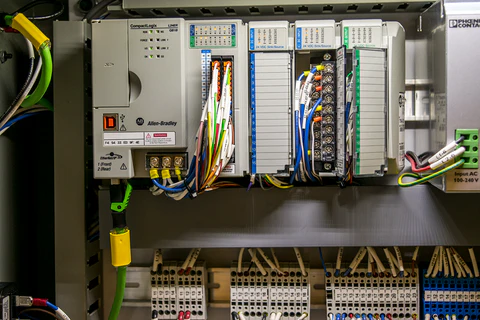
A (PLC) is a small, modular computer that monitors and controls industrial processes and machinery. PLCs are used in many industrial control systems (ICSes) and have replaced mechanical relays, drum sequencers, and cam timers.
Here are some things to know about PLCs:
  • How they work
    PLCs monitor the state of input devices, like a light switch, and then decide what to do with the output device, like turning the light on or off. PLCs work in a program scan cycle, which consists of reading inputs, executing the program, and writing outputs.

  • Benefits
    PLCs can improve efficiency, reduce costs, and automate complex tasks. They can also be customized to perform different types of industrial applications.
  • Types
    PLCs come in different sizes and form factors. Unitary PLCs, also known as compact or integrated PLCs, are the simplest type and are suitable for simple processes.
  • Temperature tolerance
    Most PLCs are designed to operate safely within 0 to 60°C, but some can operate at extreme temperatures.
  • Memory
    PLCs need enough ROM and RAM to execute the processes they automate. ROM stores the operating system and instructions, while RAM executes the functions.
  • Connectivity
    PLCs need enough input and output ports to connect to the peripherals required by the system.
PLCs can be used for many everyday actions, such as controlling street lighting, traffic lights, digital signage, and more.